Microwave radiofrequencies, 5G, 6G, graphene nanomaterials: Technologies used in neurological warfare
Fabien Deruelle, Independent Researcher, Ronchin, France
https://pmc.ncbi.nlm.nih.gov/articles/PMC11618680/pdf/SNI-15-439.pdf
HUMAN-MACHINE FUSION (CYBORG)
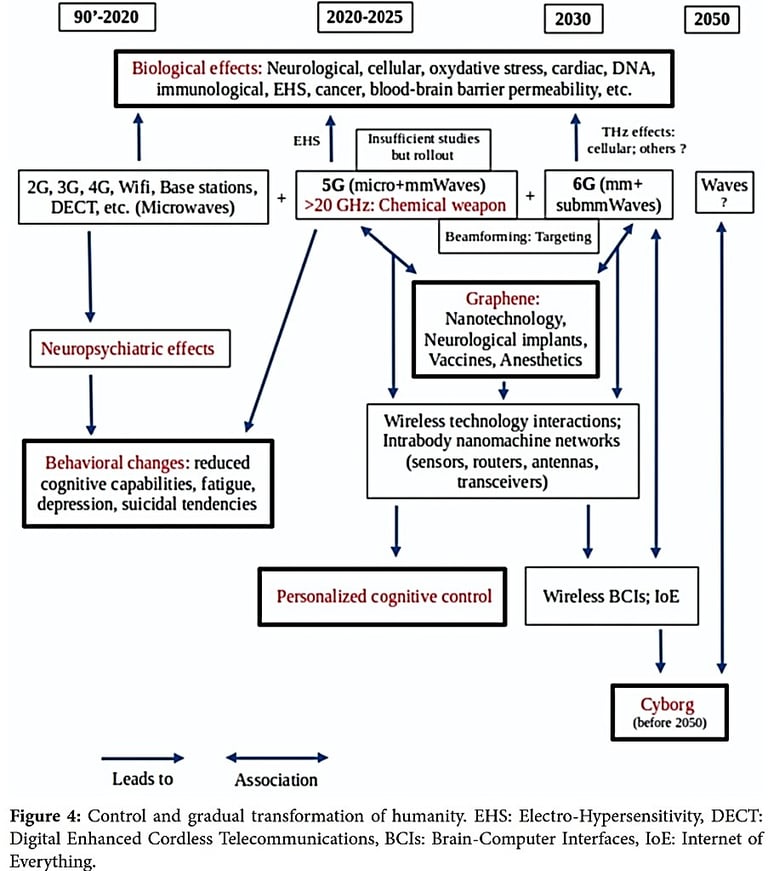
Scientific publications and military documents clearly show that the goal for the coming years is human-machine fusion.
Medicine will first employ graphene brain implants.[21] Carbon nanomaterials can be connected to implantable brain-computer interfaces (BCIs),[89] and graphene nanosensors appear suitable for operating non-invasive BCIs.[48]
Via the vascular circulation, nanorobots (some carbon nanomaterials are being studied) could cross the BBB and attach themselves to the axons of neurons in the brain, which could then connect to the internet cloud through a BCI.[101] It should be noted that optimizing a BCI seems to require the intervention of artificial intelligence (AI) to study brain functions, but also to identify and monitor the neurons that control behavior.[139] e huge volumes of data exchanged between the cloud and the human brain will require AI to manage these interactions, too.[101] 6G network applications (2030) will enable wireless brain-computer interaction.[31] While 5G will enable wireless communication between simple physical objects (IoT), 6G, in which AI will play a key role, will bring networked communication of humans, processes, files, and objects (Internet of Everything (IoE)), such as people-to-machine and people-to-people connections via the internet.[13,75]
In 2023, a NATO document on the biological functioning of cognitive warfare shows that one of the most promising
WEAPONIZATION OF TECHNOLOGY
Cyborg by 2050
Weaponization of Technology


Race To Weaponise The Mind: How Brain Weapons Alter Memory & Behaviour
https://www.youtube.com/watch?v=ns9c1vD-hDE

The Battle For Your Brain Begins, Experts Warn: Your Thoughts Are At Risk
https://www.youtube.com/watch?v=U8UzY5qxw6Y
The Battle For Your Brain Begins, Experts Warn: Your Thoughts Are At Risk
https://www.youtube.com/watch?v=U8UzY5qxw6Y
What technologies are already or will be weaponized?
FBI - Atlanta Central Intelligence Agency (CIA) FBI,
Federal Bureau of Investigation, National Security Agency (NSA), Defense Intelligence Agency, (DIA) U.S. Mission to NATO (US NATO), U.S. Department of Defense (DoD), U.S. Department of State (DOS)
Neuroweapons encompass biological agents, chemical weapons, and even directed energy targeted at the brains and central nervous systems of enemy combatants. According to some observers, neuroweapons have the potential to disrupt everything — from individual cells in a body to societies and geopolitics.[1]
Understandably, there are serious ethical concerns about the use of neuroweapons and what could happen if they got into the wrong hands. For example, in 2021, U.S. officials accused China of using emerging biotechnologies to try to develop “brain-control technologies” through military applications that included gene editing, human performance enhancement, and brain-machine interfaces.[4]
Even the U.S. Brain Research Through Advancing Innovative Neurotechnologies (BRAIN) Project,[5] launched in 2013, has gone in some questionable directions. The BRAIN Project was initially presented to the public as having the potential to produce research with vast beneficial health implications. However, much of the funding went through the Defense Advanced Research Projects Agency — a military organization. When science and military are mixed through dual-use research, the priorities of the latter often dominate the trajectory of the former.[6] In 2013, the U.S. National Institutes of Health reported that the BRAIN Project was looking to develop electromagnetic modulation as a new technology for brain circuit manipulation, heralding a shift in research from drug research to brain circuit research. Specifically, the project intended to explore optogenetics, which involves injecting neurons with a benign virus that contains genetic information for light-sensitive proteins.[7] The brain cells then become light sensitive themselves, and their activity can be controlled with millisecond flashes of light sent through embedded fiber optic cables. This kind of research has alarming implications, and the development of these kinds of technologies should be heavily regulated.
To advance brain science and ensure neuroweapons of this type are not developed or used, it is essential that major players in the Americas, Asia, and Europe collaborate as they each have comparative advantages and have focused their research in a coordinated and coherent way in the past. The recently launched China Brain Project (CBP) could offer opportunities for international cooperation with researchers at the U.S. Brain Initiative and the EU Human Brain Project.[8] The CBP seeks to understand the neural basis of cognitive functions, diagnose and treat brain disorders, and conduct brain-inspired computing — research that could complement the work being done in the U.S. and EU.
Above all, it is crucial that brain science is used to improve brain health and is not used for harmful purposes. International treaties banning the development and use of neuroweapons should be strictly adhered to.
Join us in advocating against harmful technology misuse.
contact@targetedhumans.org
© 2025. All rights reserved.
Targeted Humans Inc.